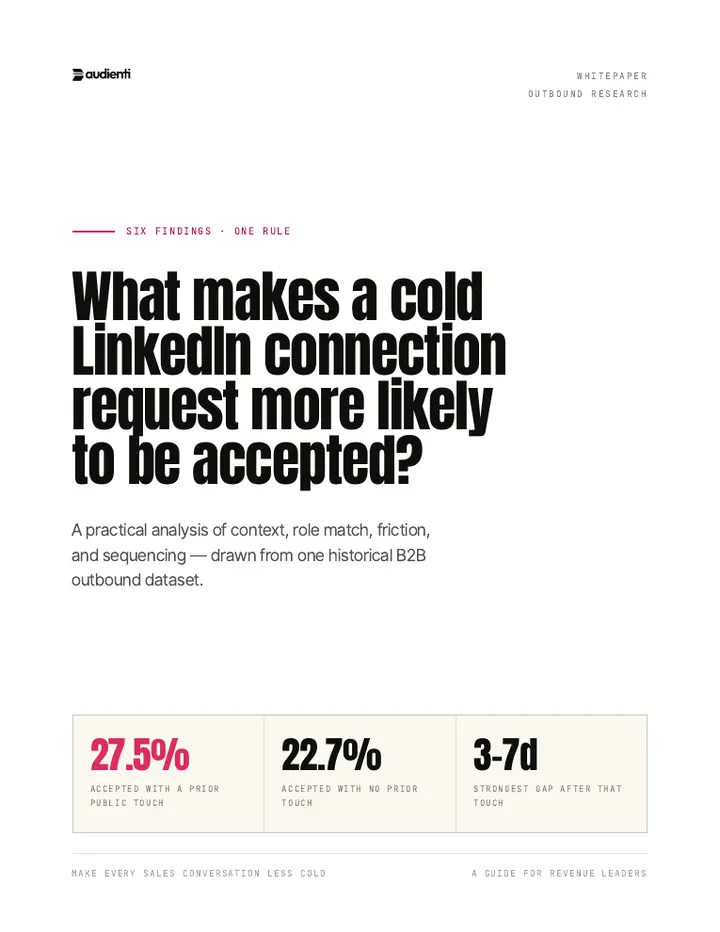
27.5%
acceptance when a public touch came first
Original research, free PDF
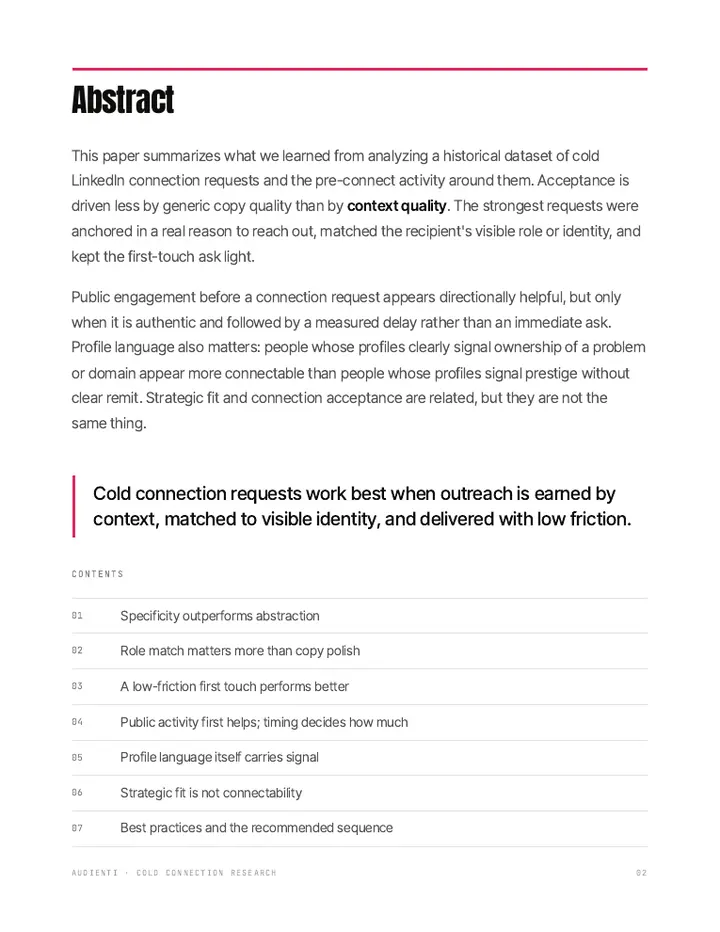
Acceptance is driven less by copy quality than by context quality. In our analysis of a historical B2B outbound dataset, the strongest requests had a real reason to exist, matched the recipient's visible identity, and kept the first-touch ask light. Clever templates mattered less than all three.
16 pages. Fill in the form and it downloads on the next page.
27.5%
acceptance when a public touch came first
22.7%
acceptance with no prior touch
3-7 days
the strongest gap between public touch and request (median 3.8 days)
Directional findings from one historical dataset, not a controlled trial. The paper says so too.
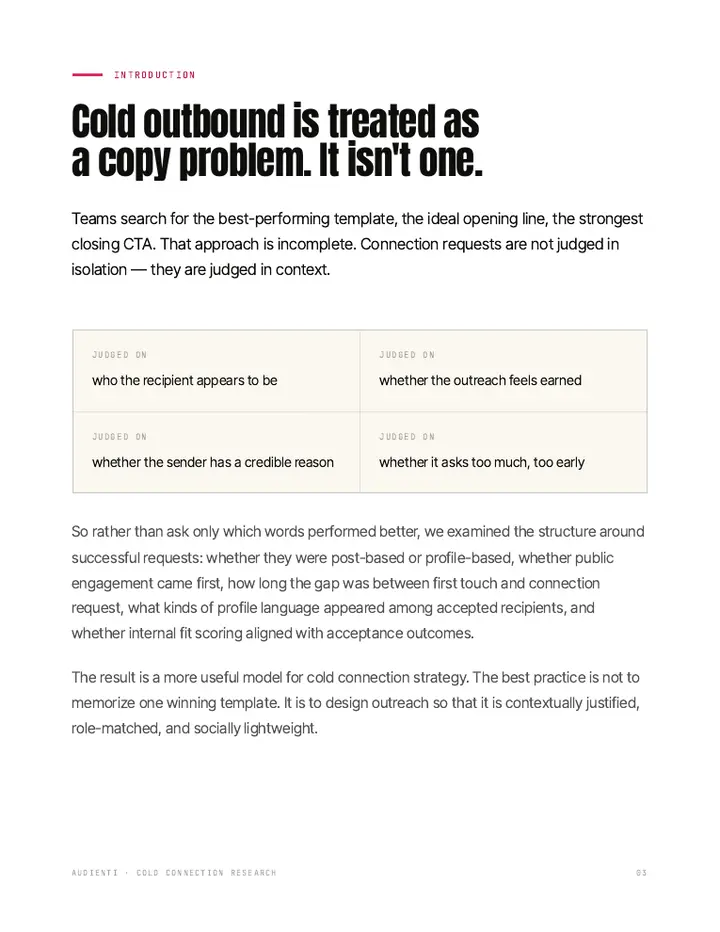
This research is based on one historical B2B outbound dataset. It is not a controlled trial. Some sample sizes were small. These are directional findings, not definitive rules. Use them as a starting point, not as guaranteed outcomes.
01
Requests tied to something concrete the recipient recognizes (a real post, a visible responsibility, a named function) beat requests built on broad theses or generalized curiosity.
02
Many failures are category errors, not bad writing: coherent copy addressed to the wrong identity. Write to the remit the person visibly owns, not to a market thesis.
03
Short, specific, low-pressure requests beat heavier asks like 'share your perspective' or 'open to chat.' The first touch creates openness; it does not extract engagement.
04
Requests preceded by a public touch were accepted 27.5% of the time versus 22.7% with none. The lift came with a delay: the strongest window was 3-7 days after the touch, not minutes.
05
Accepted recipients tended to have profiles that clearly answer 'what does this person actually own?' Legible ownership beat impressive-but-vague seniority.
06
Higher internal fit scores did not map cleanly to higher acceptance. Fit asks who matters strategically; connectability asks who will accept a cold approach. Different questions.
Read the hook first, then pick the route. Better than forcing one sequence onto every target.
Route A
Strong post hook, and a natural public contribution to make
Engage publicly, wait 3-7 days, send the request
Route B
Strong post hook, but no genuine reason for a public touch
Send the request now
Route C
Profile-based hook, and the profile clearly signals role ownership
Send the request now
Route D
No strong hook at all
Do not force outreach
The durable principle: cold connection requests work best when outreach is earned by context, matched to visible identity, and delivered with low friction.